Brontoscopy & Ceraunoscopy
n. divination by thunder (brontoscopy) and lightning (ceraunoscopy)

Some forgotten words are useful, others are just strange or wondrous. Today’s dual entry fit into the latter category.
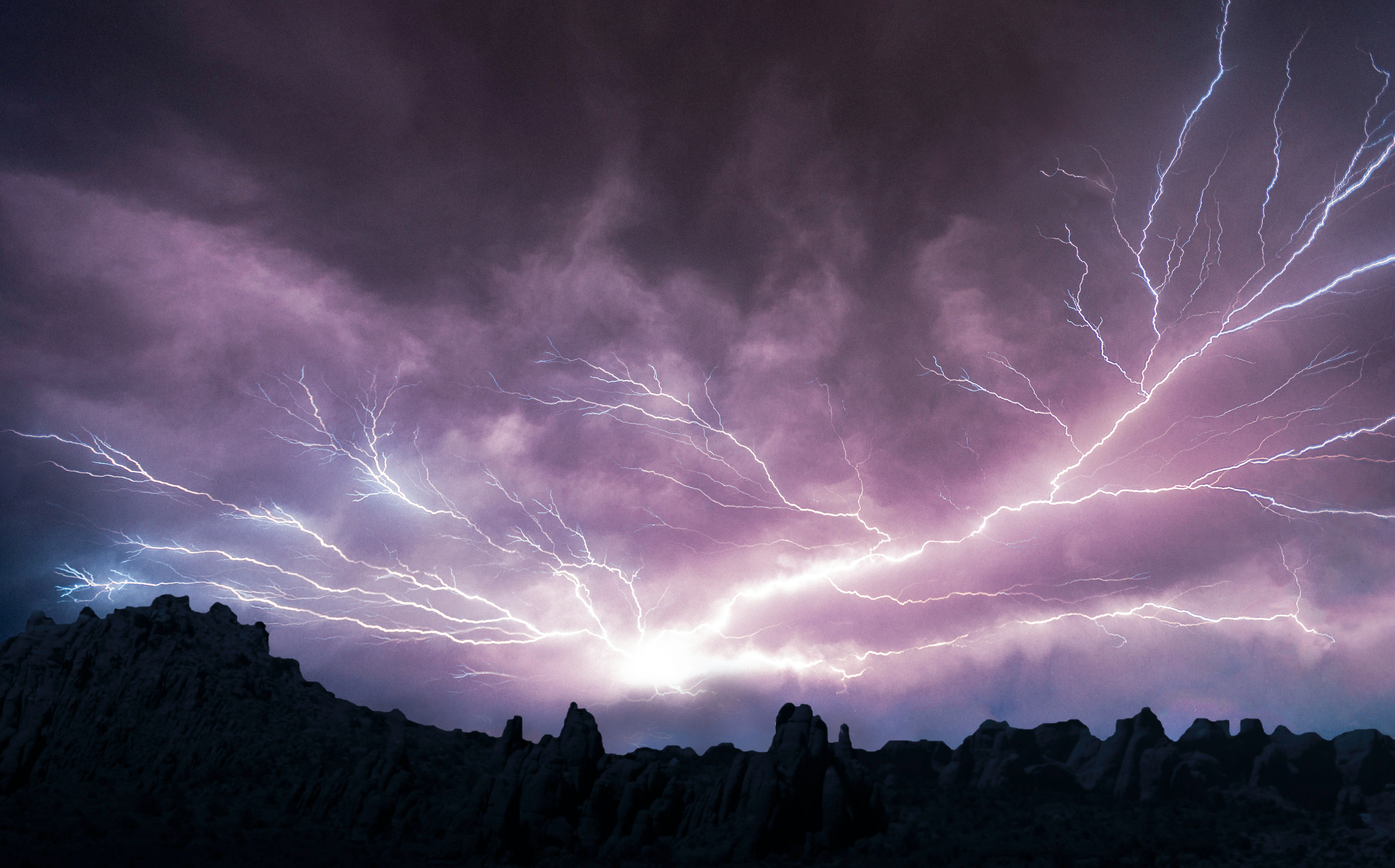
Light arrives with no time elapsed, while sound follows later, dragging itself through the air on its own dumb errand. There’s a gap you can count. Children are taught to measure the distance between the flash and the boom on their fingers, one second for every mile. The event and its voice always separated by an interval.
The Greeks called the practice of interpreting thunder brontoscopy, and the related practice of interpreting lightning ceraunoscopy. The Etruscans, Romans, Babylonians, and seers in ancient India all used some form of ceraunoscopy and brontoscopy, most likely as state-sanctioned forms of divination, over a period of approximately 1,100 years (700 BCE to 400 CE). For over a millenium most major military campaigns, harvest plans, and political elections were likely initiated by first checking the sky for signs.
The ceraunoscopist and the brontoscopist would have received highly specialized training, focusing specifically on lightning and thunder, which they believed to be a version of God’s tongue. Each served as a form of seer or priest.
Lightning burned what it burned, and went where it went in that instantaneous, twitching wink of light. The diviner, watching long enough to see the still smoking shape of scorched grass or which trees split and which remained untouched, believed he had been given a celestial answer to a mortal question.
Thunder arrived differently, and so it was likely read differently. Unlike the lighting diviners, we don’t know for sure how the brontoscopist actually worked with thunder. I imagine that the thunder rolled in from wherever the strike had been, already old news by the time it reached the ear. The event and its voice connected, yet permanently estranged. The Etruscans, at least, left a trace of their method, which had little to do with the sound of thunder itself. They kept a calendar with annotations for thunder events, so that thunder heard in one week or month foretold a harvest whereas the same sound a week later may have foretold a death or some other event. The Etruscan brontoscopist wasn’t reading the thunder, so much as tracking it in time, and (in some unknown way) correlating the sound with future events.
I imagine these divinations to be one of the oldest forms of knowing through worship, delivered rather than arrived at through deduction. Through these modes of divination, messages would have arrived as irrevocably true, giving the diviner immense power.
There was no mercy in this. The storm waits on no man’s readiness, coming down like a momentary shattering of heaven’s floor. Striking a field, a roof, a lone oak, and done before any observer has time to close their eyes against the light. Closing with a long echoing boom.
What remained was interpreted as fact. The practices of brontoscopy and ceraunoscopy were both rooted in the idea that the gods speak through weather events. Perhaps this is why the practice feels so haunting to me.
The ancient diviners recognized a truth that contemporary knowing resists: reality reaches its conclusions long before it breaks into human awareness, completely indifferent to whether or not (and how) humans might learn of it. In an age of frantic spin and curated realities that intentionally ignore science and facts, we have forgotten that truth remains indifferent to our arguments, striking down with the terrifying finality of an ancient storm. A thing, like gravity or the spread of a toxin, becomes irrevocably true in silence, indifferent to our preferences. We are left to enter the interval between an event and understanding through our own partial methods of comprehension. We stand in that gap waiting for the sound, imagining that delay means uncertainty, when all along the decision was made long ago and is final.
If one is close enough, after a strike there is the smell of air that has been struck instead of burned. A strange thinness, as though some portion of the sky has been scraped clean and will no longer hold a scent as it did before.
A man stands in a field that has just become the parchment for some divine message and reads what he can of it, knowing the reading will be incomplete. The storm (not unlike the practices of ceraunoscopy and brontoscopy themselves) has already moved on to the next ridge, indifferent to whether anyone finds words to communicate what has been revealed.
Brontoscopy & Ceraunoscopy
(n. interpreting divine messages by thunder or lightning; divination by storms)
Lightning uses an alphabet
older than light,
but thunder is the voice
that spells it out.
Sky splitting
for a moment,
the world shows its bones.
Ceraunoscopy is reading
those brief anatomies,
truth revealed
at unbearable voltage.
Brontoscopy is hearing
those heavy vibrations,
meaning revealed
at stunning volume.
Storms never warn.
And when they leave,
the air holds residue
of things we were not meant
to know.
Brontoscopy. (n.; English/Ancient Greek; 1656 / c. 500s CE; Rooted in the ancient Greek brontē (thunder) and skopia (to watch or examine)).
Ceraunoscopy. (n.; English; 1758; An 18th-century academic hybrid combining the Greek keraunos (lightning) and skopia (to watch or examine)).
Note: While both terms refer to the act of extracting meaning and omens from the skies, they have very different histories. One is an authentic ancient artifact, while the other is a relatively recent academic invention. I am using the newer word here in this entry because although we know for certain that ancient seers divined by lightning, we do not know for sure what they called it.
Brontoscopy is the linguistic survivor of a genuine, living ancient practice. We know of it because classical and Byzantine scholars, most famously the 6th-century schiolar John the Lydian, actively used the term brontoskopia to describe the highly secretive religious traditions of the lost Etruscan seers. Thanks to these fragile historical records, we possess the fragments of an ancient “Etruscan Brontoscopic Calendar,” a document that mapped thunder as a literal language spoken by the gods. When the term finally entered English in the mid-17th century, it arrived as a direct bridge to an authentic classical ritual.
Ceraunoscopy, by contrast, is a modern academic invention. While we know for certain that ancient seers divined by lightning (the Romans even weaponized the sighting of flashes to dissolve the Senate in specific documented occasions) they didn’t leave us a single, standardized name divining by lightning. Instead, ceraunoscopy was retroactively manufactured centuries later by academics who heavily borrowed Greek roots to neaten up classical dictionaries. It was born as a prestigious-sounding name for a documented practice whose original vocabulary had been forgotten.
State-sanctioned divination collapsed as Christinity consolidated power across the collapsing Roman Empire. The State systematically dismantled the state-sanctioned practices of seers and outlawed divination as a pagan heresy.
Interestingly, the second half of both words (“-scopy”) comes from the Greek skopein, meaning “to observe, examine, or read closely.” Over the centuries, this root underwent a profound shift, evolving from a magical act of scanning the sky for divine messages into a scientific or empirical act of looking down into physical matter through tools like microscopes. Because of this linguistic evolution, using these words today carries a haunting weight: they remind us of an era when human beings looked outward into the infinite to find certainty through magic, rather than looking inward into aspects of phenomena using the scientific method.