

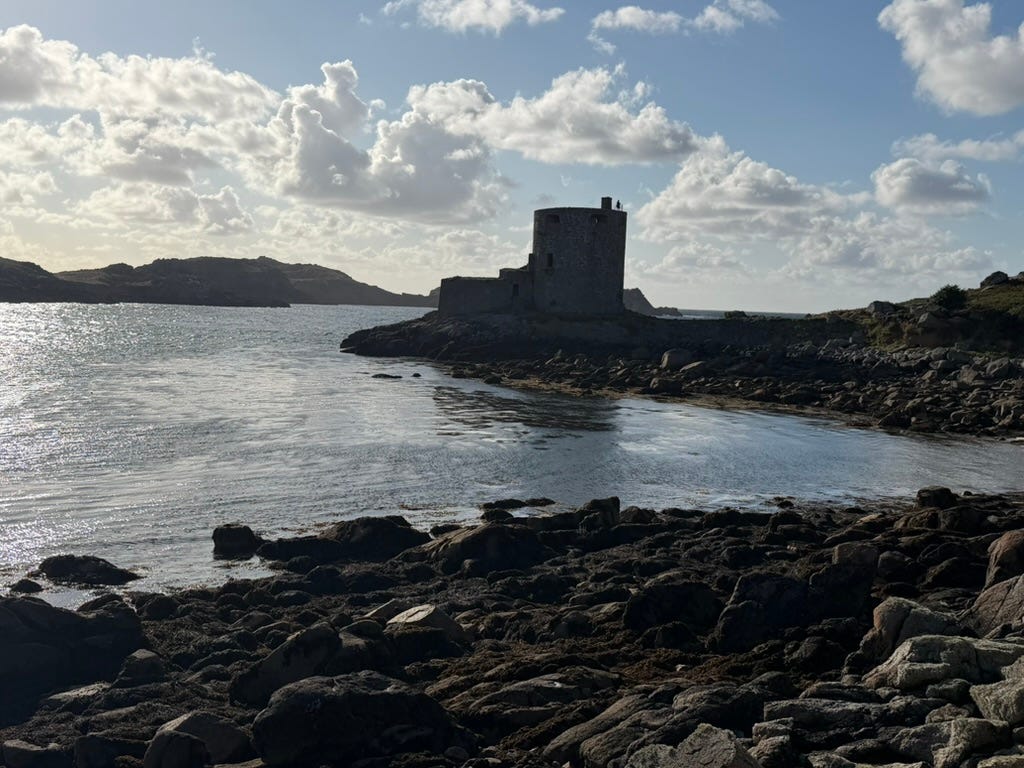
Dear reader, today's word is more of a journal entry, inspired by spending some time in the Western-most part of England, including the Western English isle of Tresco and several of the smaller coastal towns in Cornwall.
“In this year fierce, foreboding omens came over the land of Northumbria, and the people were wretchedly terrified... and a little after that in the same year on 8 June the harrying of the heathen miserably destroyed God’s church on Lindisfarne by rapine and slaughter.”
— The Anglo-Saxon Chronicle circa 890 AD“Yeah, there is one thing. My own morality. My my own mind. It’s the only thing that can stop me.”
— Donald Trump, New York Times interview January 2026
From the deck of our ferry, the island is a white stone spine. Resting under a shifting leaden sky, we’re caught in what feels like an ancient motion. One that we have participated in many times before.
Sea-faring Norse traveling in longboats called forced landings or raids the "strand-högg." Norse sea-rovers sometimes landed unexpectedly, butchering livestock and taking what they wished before local drift-men could gather a defense. Violence shaped the word, and its vowels are stiff with the muscle of posture.
Over centuries, the idea of regional sea-kings scrambling from waves to take timber, provisions, and slaves eventually matured into admiralty charts, state-sponsored journeys, and global grids. Today, castle ruins serve as evidence of a watch that met every unfamiliar sail as a verdict, until the horizon itself became a thing to be feared. It grew into a cold tradition of maritime arrival as absolute domain that lasted centuries.
On this trip we carry no axes or cannons, only passports and the heavy certainty of a culture that reeks of command. As I walk, two distinct currents of empire briefly touch.
Standing as an American here on this British shore is to feel a strange, mirrored inheritance. I step onto an island whose own history is steeped in maritime predation. Yet I do so wrapped in the immense, unasked-for cultural weight of a newer empire across the Atlantic. I read about Americans who travel now, finding ways to claim other nationalities or hide their heritage, but neither seems possible or practical here. Strangers remind me that I hail from a culture that has an enduring history of claiming of every horizon under the banner of nationalism, and that is still too young, careless, or immature to understand itself or the shame of this posture to the world. That shame tends to arrive late, if at all. Empire is easy to defend, as long as it still works for those defending it.
Sea birds wail over the pierhead, swinging wide into a lifting draft. Travelers always bring their own needs, intentions, and expectations to foreign shores. This is really all that makes up the difference between taking and visiting.
Strand-högg
(n. a tactic of raid used by Vikings to gather stores for their ships, slaves, and eventually power in the form of leverage.)
Kittiwakes sing
of narrow escapes,
practiced since
some ancient dawn.
A scattered cacophony
of song,
torn from the wind.
Sea's kelp hair
lifts and bows
in blowing strands
with the wake,
sick with the blood
that birthed
this strange eternal
transgression.
Stone stands blind,
a round, hollow lung
choked with grey light,
that knows no language
save the battery of the gale.
Above the surge,
shadows fall,
heavy, measuring eyes
that see every granite ledge
as a place to own.
This place entire
listens for the keel:
the spine that bows back,
breaking waters
to bend the shore.
Strand-högg. (Old Norse compound noun; c. 850-1000; from strand (shore, beach) and hogg (blow, strike). Literally something like shore strike, or shore raid)
A raiding practice that likely lasted from the 9th century through the mid-11th century. The word itself only survives through 13th century Icelandic sagas, handed down through oral tradition.